How it works
The detail behind the plan.
How Lautly plans your day and your week, measures readiness, runs mock tests, and teaches A1, A2 and B1. For the short version, see the overview.
One button. Your day is planned.
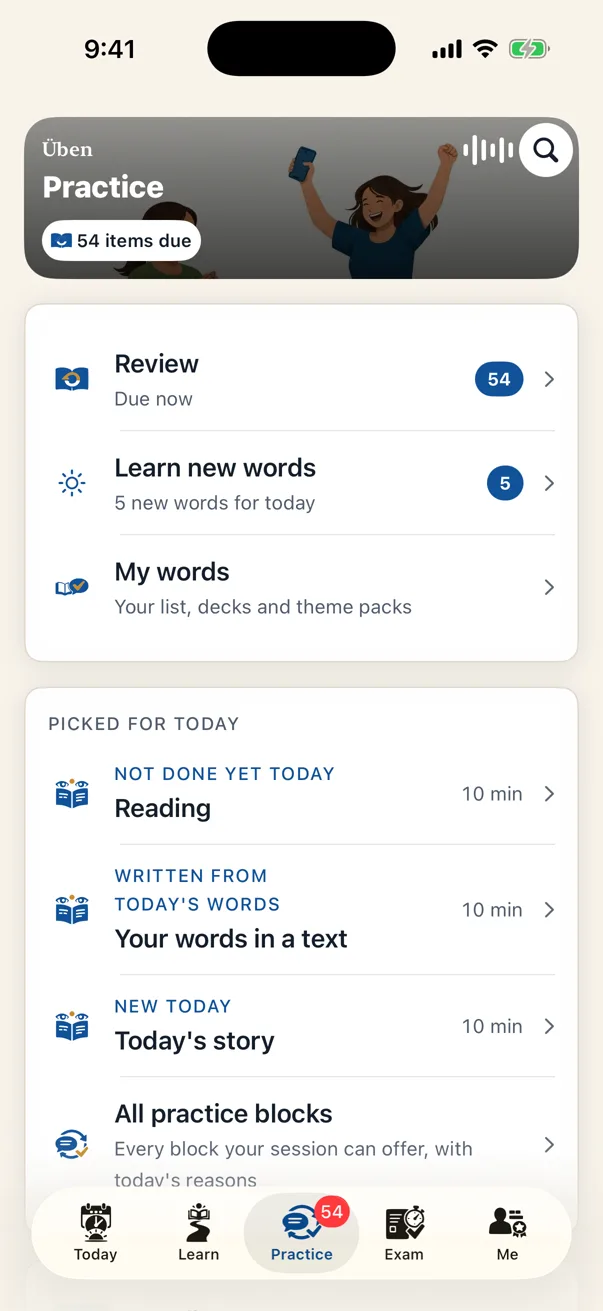
You choose how long and how often. Lautly decides what. Each day opens with one button, and the session behind it is built from your due reviews, your next lesson, your exam and the minutes you set.
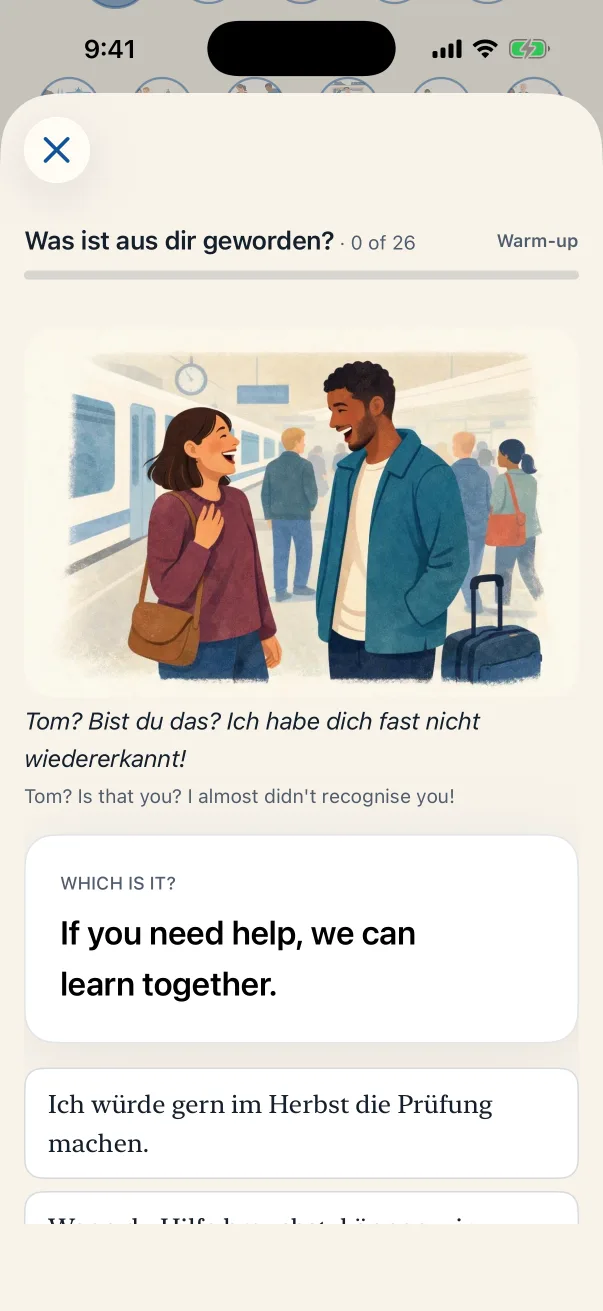
- Warm-up: the words and articles due today, nothing else
- One lesson from your course, stopped at the minute, not the count. What is left finishes tomorrow
- Say it: one spoken take every day, scored word by word on your phone
- Your choice: the rest of the time is yours, from three blocks picked for today, each with the reason it was picked
Choose 15, 30, 45 or 60 minutes and the days you can study. At 60 minutes the extra time becomes a second listening or reading block, never a longer lesson. Leave early, and the session waits where you left it.
Open any lesson from the course map whenever you like. A lesson finished there counts towards today’s session, because both doors write the same record.
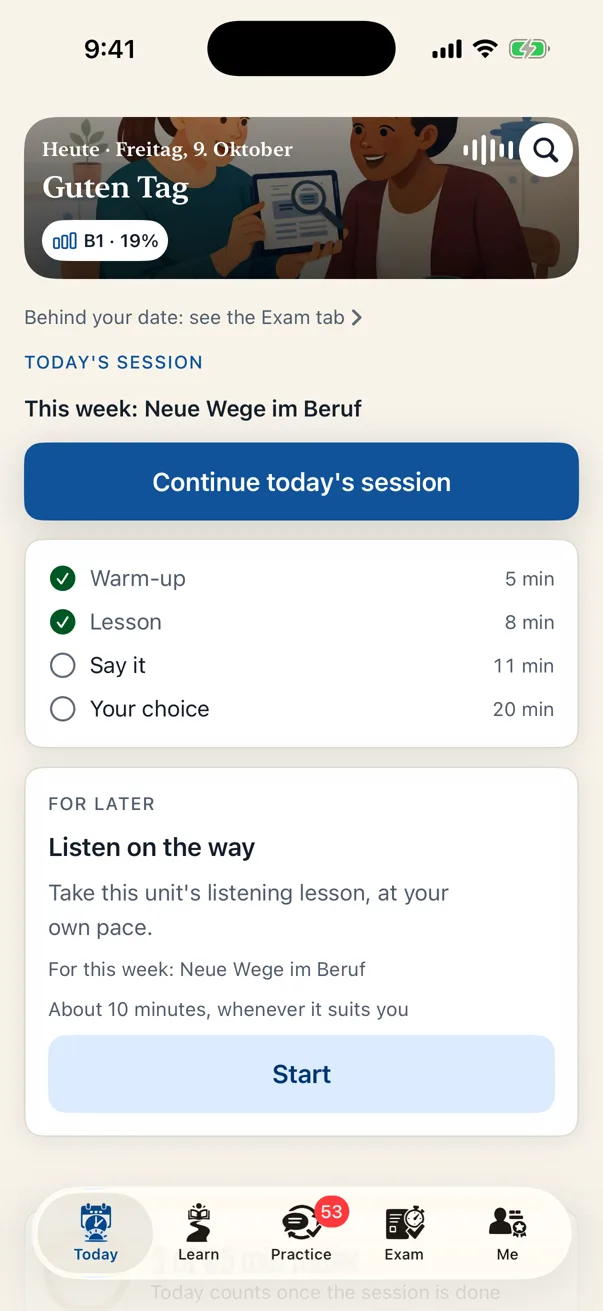
A unit a week, on your days.
Lautly plans in weeks, not days. One core lesson a day on the days you booked, and a new unit, with a new real-life task, each week. Your week starts the day you start, not on a Monday, and rest days are yours to place.
The promise, in plain numbers
Before you commit, Lautly tells you what your rhythm buys: At 30 min × 5 days a week, a unit takes 10 days. Add 2 more days a week or 15 minutes a day to make it a week. It never asks for more than 60 minutes.
| A day | Every day | 5 days | 4 days | 3 days |
|---|---|---|---|---|
| 60 min | a week | a week | 9 days | 12 days |
| 45 min | a week | a week | 9 days | 12 days |
| 30 min | a week | 10 days | 12 days | 16 days |
Worked out for a learner who gets about four answers in five right. Do better, and a second lesson on one day can be earned.
A task for later
Each session ends with one small thing to do away from the screen, sized for ten minutes: photograph five things in your kitchen and keep the words, play today’s listening piece on the way to work, record yourself ordering for two, write the note the lesson asked for, or say three sentences to your partner. Only one is open at a time. It is checked at the start of your next session, and your one daily reminder points to it while it waits.
Your week in review
At the start of each new week, one page: your days and minutes against what you booked, what became stable, at most two weak spots, one sentence you can now say, and next week’s plan with one item you may swap.
One place for your exam.
The Exam tab measures where you stand, plans what comes next, and explains how the exam works. The practice itself stays in Practice, so nothing is in two places.
- Your phase: Foundation, Build-up, Exam practice, then the final two weeks. Your session changes shape with it, and the tab says what that means
- Readiness for each part of the exam, against its pass mark, with the evidence behind each bar
- A short diagnostic mock on your third study day, so readiness is never blank
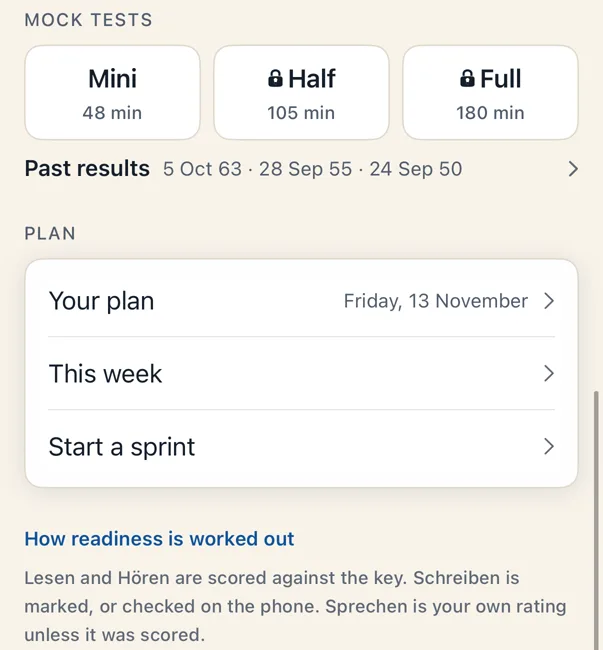
- Mock tests in three lengths, with every past result kept. In the exam phase, one a week, placed on your longest day
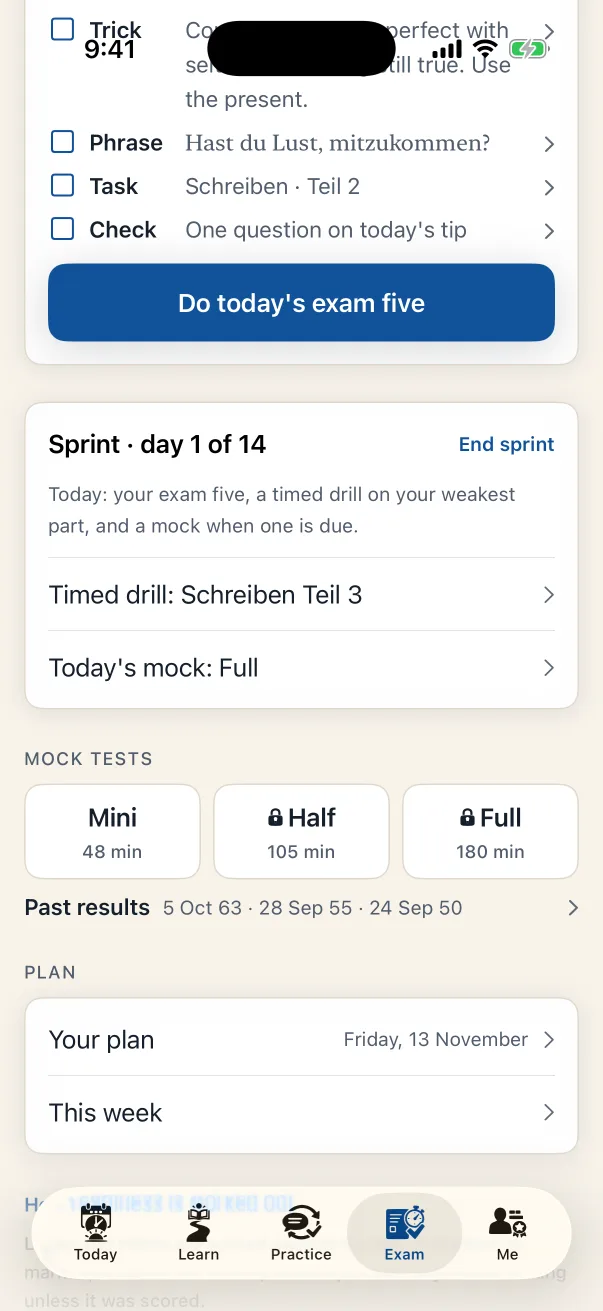
- Today’s exam five: a tip, a trick, a phrase and one task, in about five minutes
- Your plan and sprint, counted back from the exam date, and a checklist for the last fortnight
- The library: Redemittel, strategies and the exam-day guide
The fast track. With an exam date ahead and under an hour a day, each lesson runs on the items your exam relies on first. The rest comes back after the exam, or at once from 60 minutes a day.
Your exam countdown, readiness and today’s five also sit in a widget on your Home and Lock Screen.
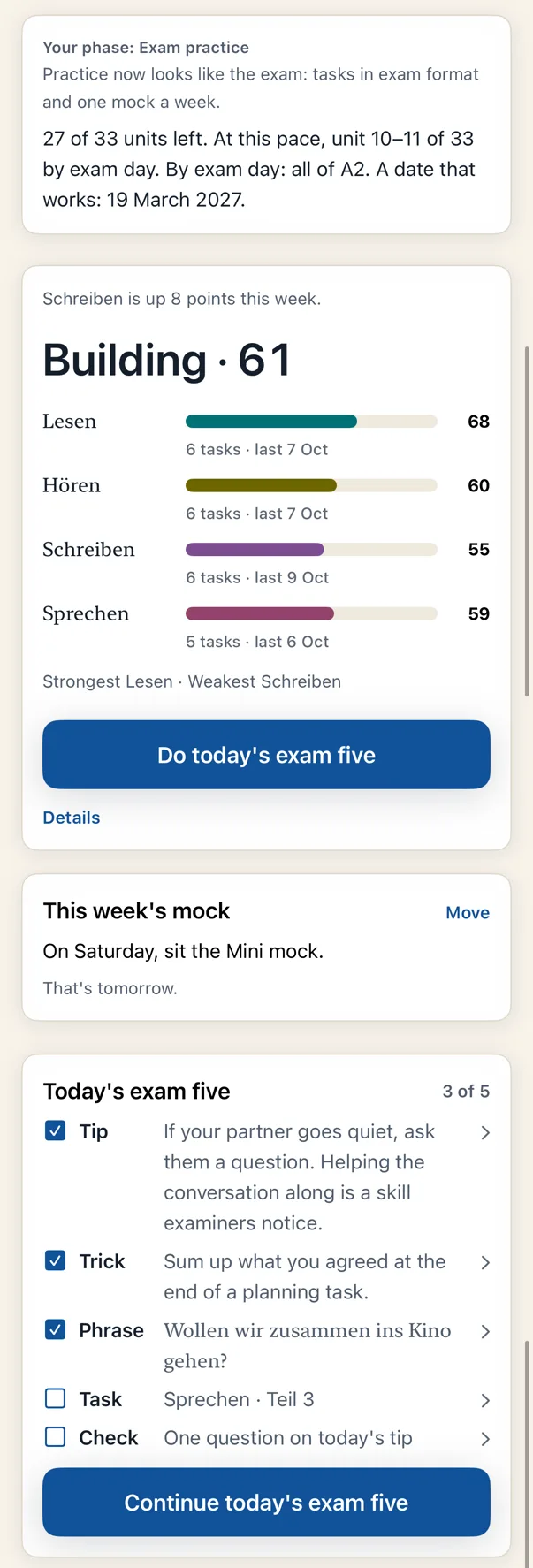
A readiness score you can trust.
Readiness is only worth something if it cannot flatter you. So Lautly counts exam work alone: exam-format drills and mock tests, not lessons or reviews.
- Each part is measured against the exam’s own pass rule
- Older results fade over 14 days, so the score reflects you now
- Too little evidence shows as “not enough yet”, never as a guess
- No part shows as ready until you have a timed result for it
- The headline is your weakest part, because that is the one that fails an exam
A week you can see.
Each week, Lautly sets your readiness now against a week ago, shows the days you did exam work, and names the parts that moved most.
After the exam, one question asks how it went. Your answer helps calibrate readiness for everyone who comes after you, and leads to your next exam or a new date.
Lautly is not affiliated with any exam provider. Readiness and mock reports measure what you have practised. They never predict a result.
Sit the exam before the exam.
Mock tests run on the exam’s own clocks, with their own material. Nothing in a mock appears in practice first, so a mock result means what it says.
-
Mini
One part of each section
A quick check across the whole exam. One Mini a week is free.
-
Half
Half the paper
For a weekday evening, when a full sitting is too long.
-
Full
The whole exam, timed
At least seven Full mocks for each level, and more where the exam comes in more than one format.
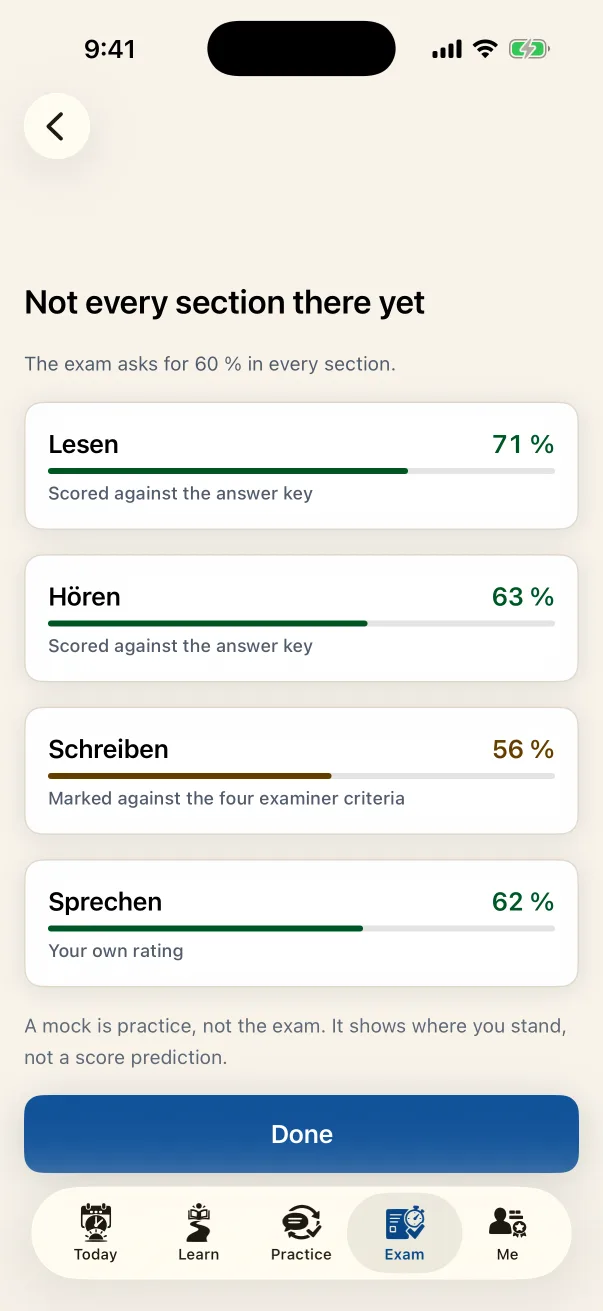
A report for every part
After a mock you see each part against the 60 % pass line. Reading and listening are scored. Writing is marked against the examiners’ four criteria. Speaking you rate yourself against the same four.
Every result, kept
Past mocks stay in the Exam tab, so you can see your progress sitting by sitting. Mistakes from your marked writing go to your Coach, beside your other habitual errors, not into a second notebook.
Practise with an examiner.
Every speaking part of the exam has scenes with an AI examiner who runs it as the real one would: the task, the questions, the follow-ups. You answer out loud. Afterwards you see which of the task’s points you met, and those results count towards your readiness.
Each sitting uses one conversation from your allowance. Pronunciation scores come with Premium.
Write it the way you will on the day.
Most written exams are on paper. Write your answer by hand, take a photo, and Lautly reads the German on your phone. Your own spelling is kept, so it is your text that gets checked, not a corrected one.
Then check each word, and submit it like any other answer.
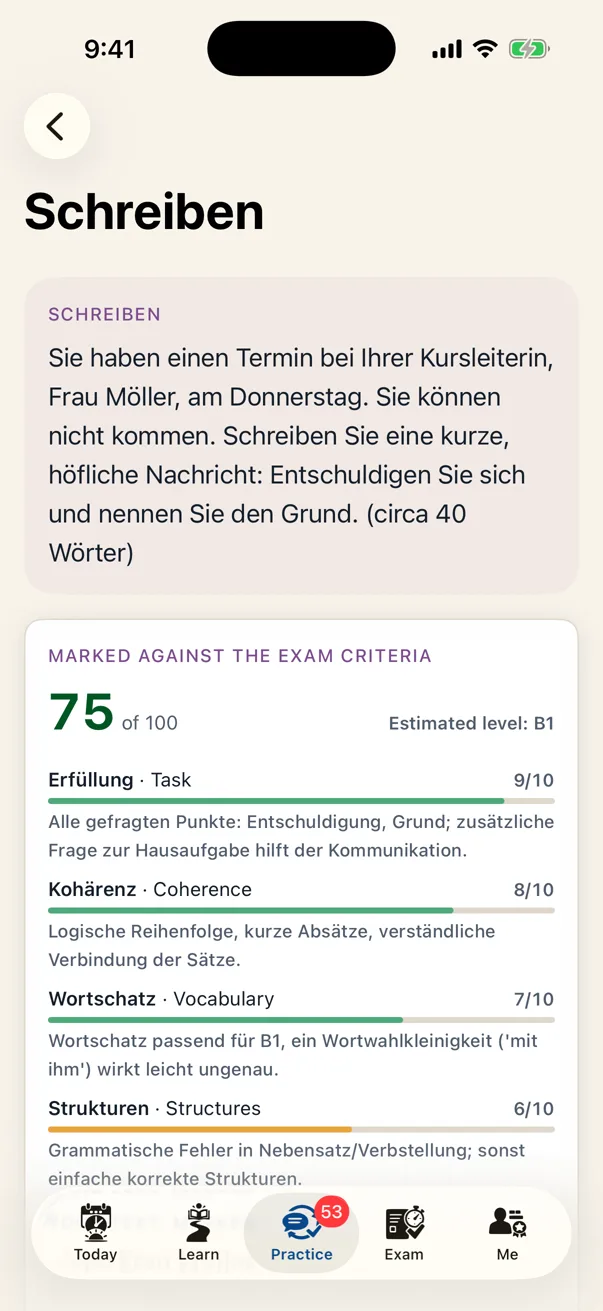
Five minutes, every day.
Today’s exam five is a short, fixed routine. It leans towards your weakest part, and changes as your date comes closer.
- A tip on how a part of the exam works
- A trick for a common mistake, or for one you made twice this week
- A phrase that earns points in speaking or writing
- A task in the exam’s format, opened in Practice
The day’s phrase also comes with your daily reminder.
Sprint in the final weeks.
A sprint is a 7- or 14-day block for the run-in to your exam. Every day brings the exam five and a timed drill on your weakest part. A Full mock opens the sprint and returns four days before the end. A shorter mock comes every three days.
The last day is for rest.
The library: what to say, and how to approach it.
The reference you would otherwise collect from books and forums, in one place and at your level.
-
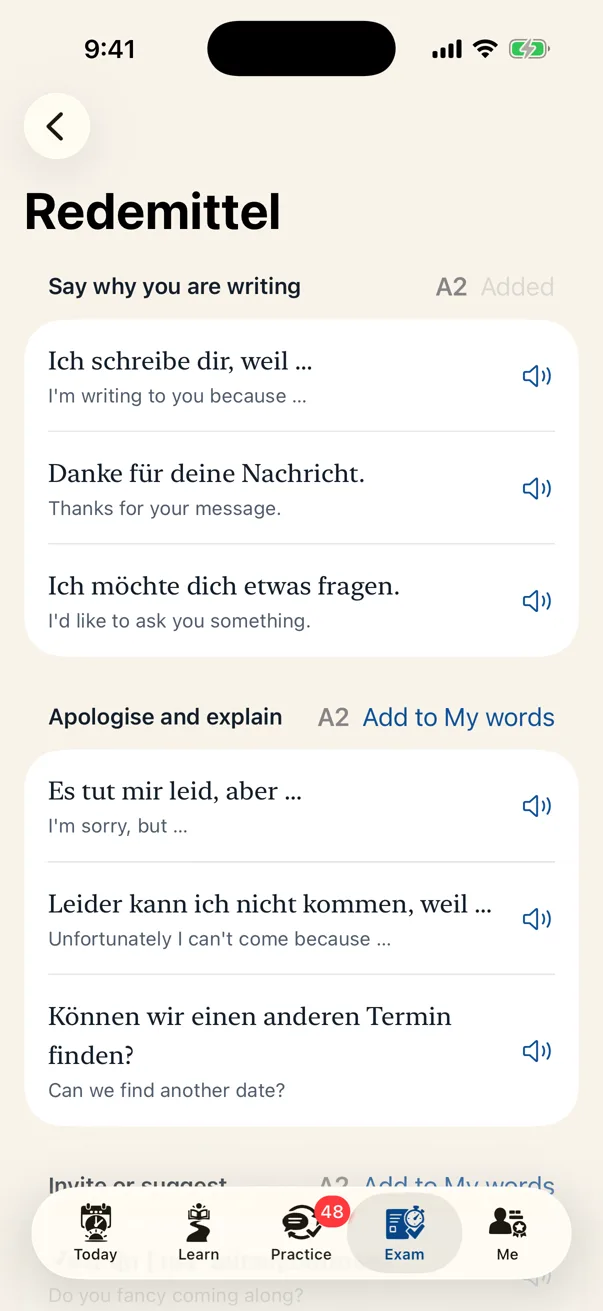
Redemittel
Phrases by what they do
Open a letter, make a request, give an opinion, disagree politely, structure a presentation. Add any phrase to My words to practise it.
-
Strategies
How to take each part
What the part tests, where time goes, and the mistakes that cost the most points.
-
Exam day
A ten-page guide
From booking your exam and what to bring, to results, certificates and retakes.
Six writing templates help you structure your first texts, then fade as you need them less.
Every skill, in exam format.
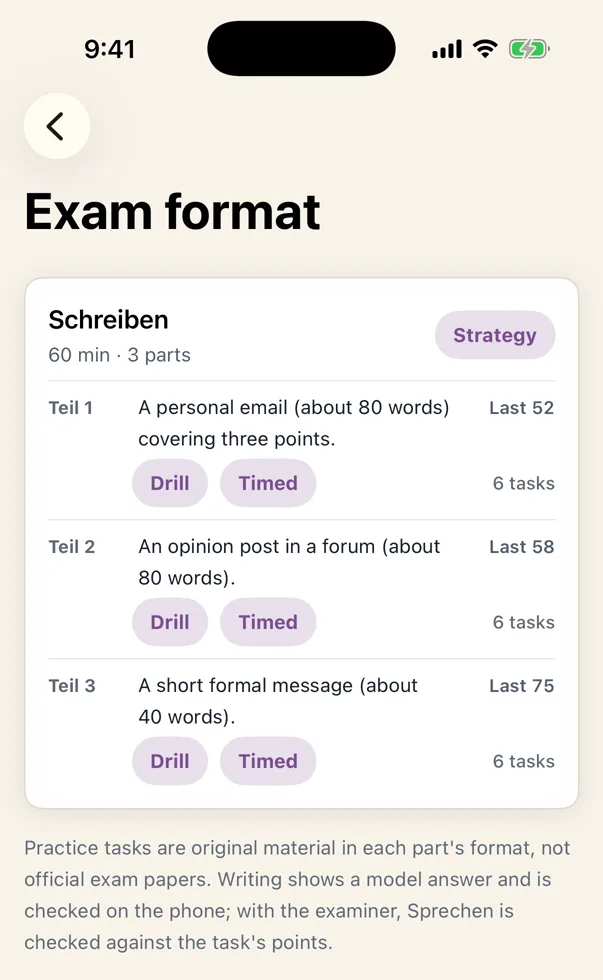
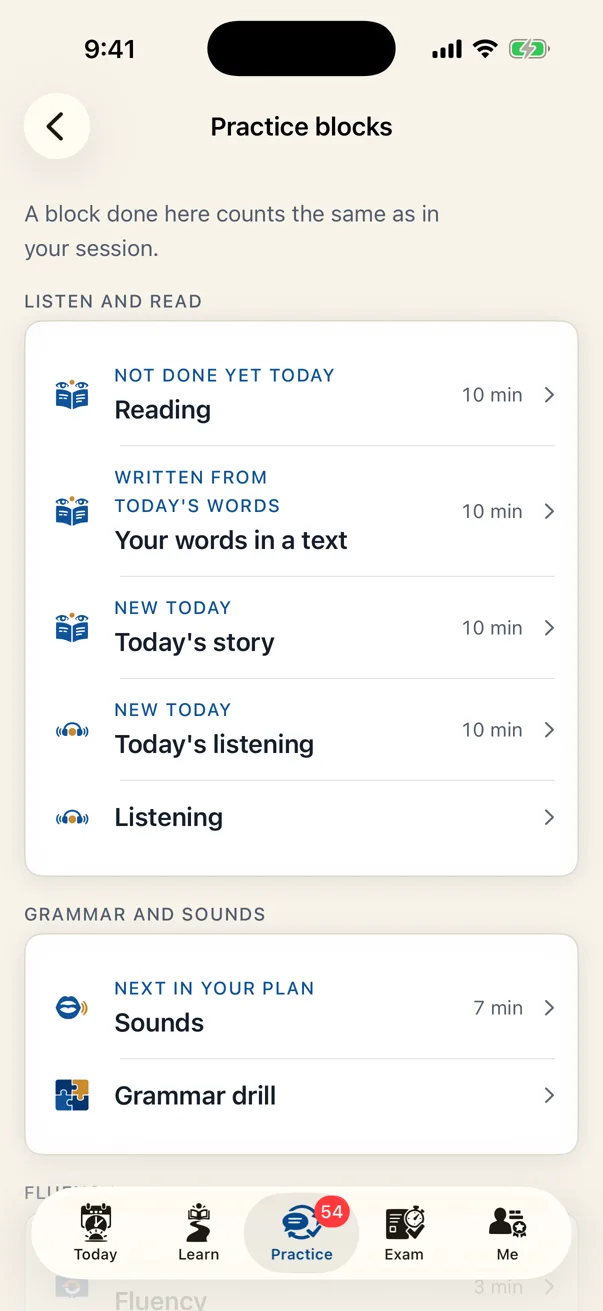
Each skill in Practice has an Exam format mode that lists the exam’s parts one by one. Drill a part untimed until it feels familiar, then do it on the clock.
-
Reading
Signs, notices, ads and messages, marked at once with a one-line reason.
-
Writing
Forms and short texts, checked for length, content points and form of address.
-
Speaking
Each part with its own task, and the examiner when you want the real thing.
-
Listening
Announcements, phone messages and radio, heard only, and as often as the exam allows.
Grammar that scores
If you have an exam set, grammar practice leads with the topics your level’s exam relies on, such as weil and the Perfekt at A2, or dass, obwohl and the passive at B1. Each answer tells you where the topic is used in the exam.
The words of the exam
Each level’s word list sits in My words. A separate pack, Prüfungssprache, teaches the German of the paper itself: Kreuzen Sie an, Ordnen Sie zu, Antwortbogen, and the signs you will be asked to read.
Three levels. One path.
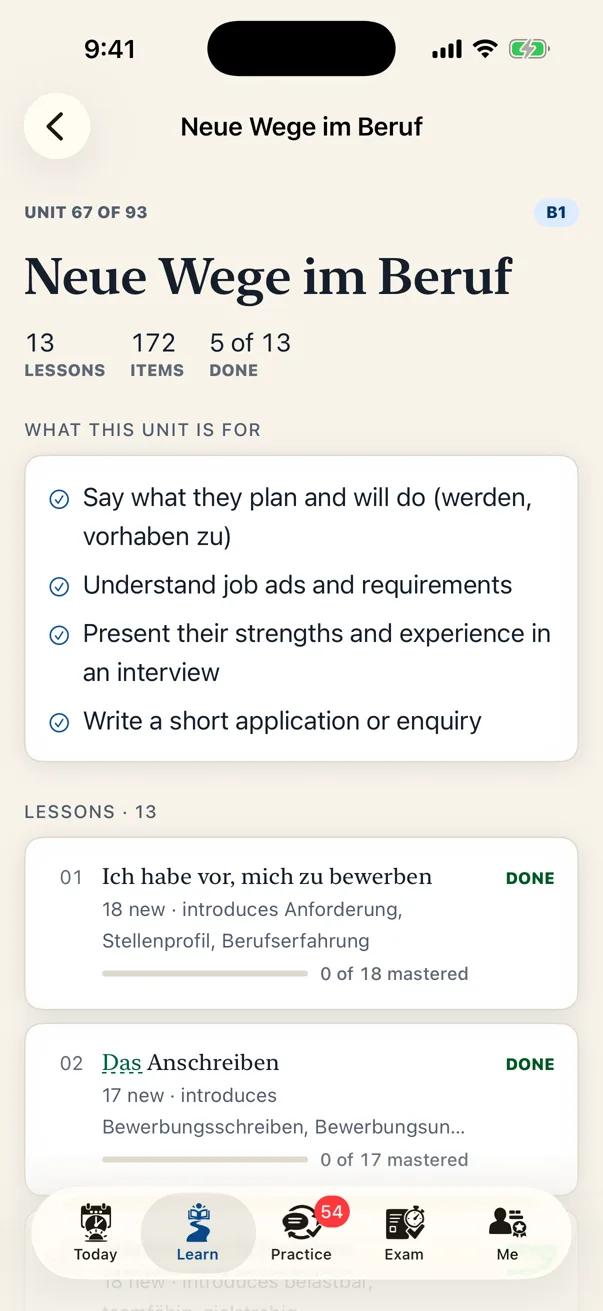
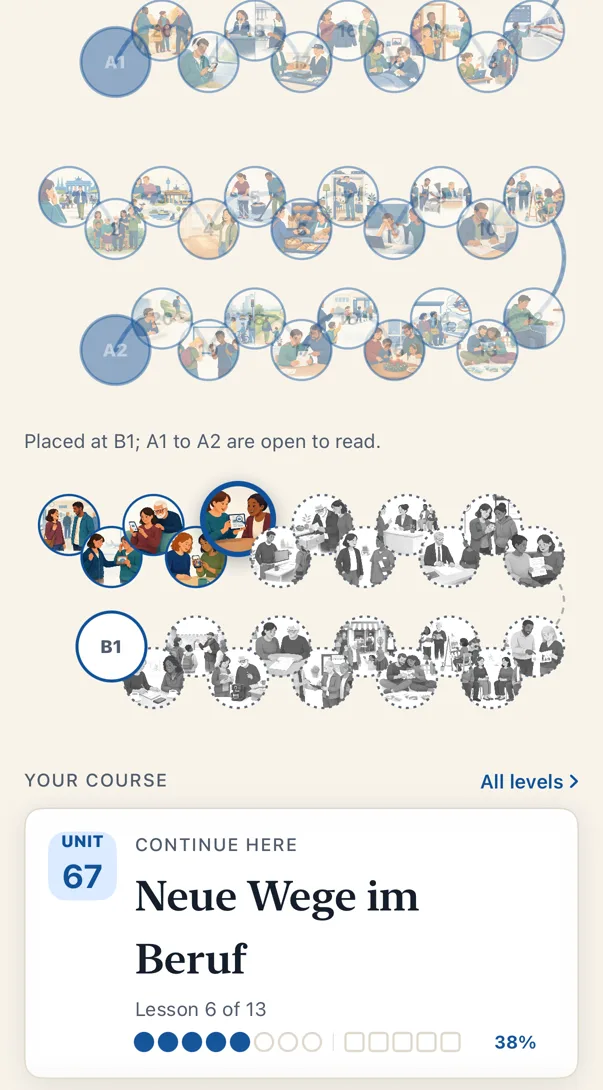
Every unit follows the same shape, so you always know where you are and what comes next. Each one trains all four skills.
-
Core lessons
New words, heard first
Five or more short lessons bring in the unit’s words and phrases, each in a dialogue before you use it. Your daily session takes one a day.
-
Hören · Lesen · Sprechen · Schreiben
One lesson per skill
Everyday texts to understand, a speaking lesson scored word by word, and a short text to write.
-
Exam stop
Every two units
A stop practises one part of the exam, plus something about life in Germany. Across a level, every part comes round.
A1
20 units, 10 exam stops, 233 lessons. From introducing yourself to shopping, the doctor, work, offices and school. The first two units are free.
A2
20 units, 10 exam stops, 210 lessons. The same people, a year later. Writing and speaking tasks follow the exam’s format. The first two units are free, the rest with Premium.
B1
22 units, 11 exam stops, 275 lessons. Work and care, offices and rights, money and contracts, media and democracy, with a picture for every word. The first two units are free, the rest with Premium.
Six theme packs sit alongside the course: flat hunting, the doctor’s, the bakery, the office, job applications and dealing with the authorities.
Inside the app
Real screens from the current build, on an iPhone, October 2026.
A grammar course you can ask.
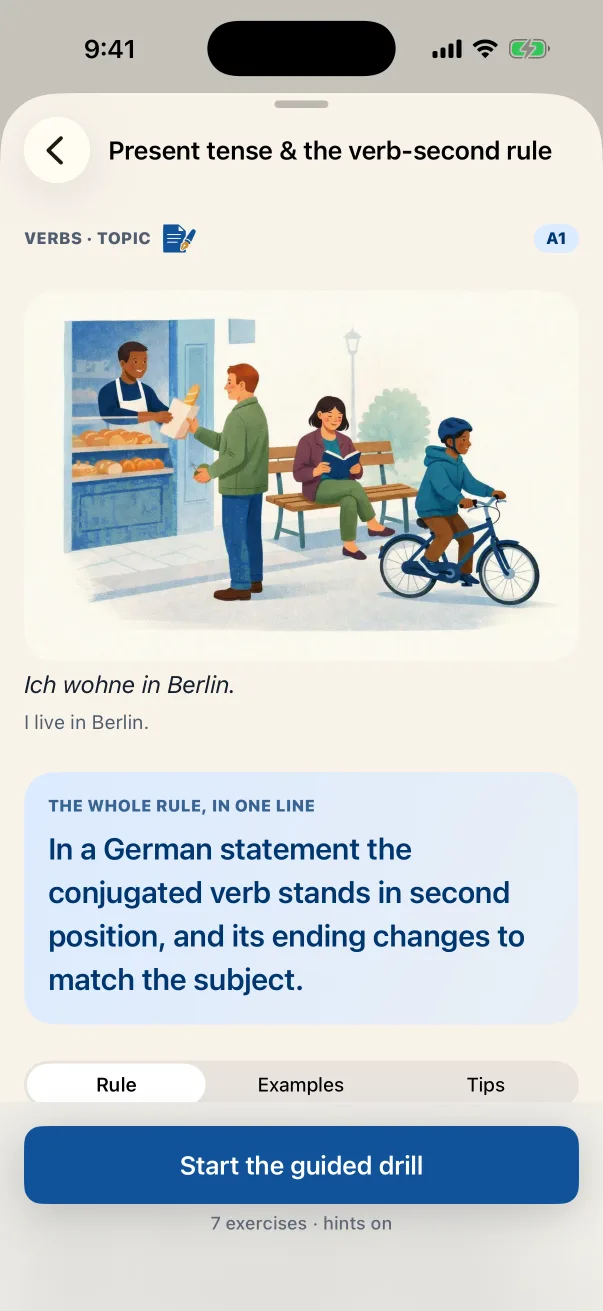
72 topics from A1 to B1, in the order you need them. Follow the path beside your lessons, open the map of the whole syllabus, or type a question: im Kino or ins Kino? The answer comes first, then the topic behind it.
Each topic opens with the whole rule in one line. Some rules you can watch: the ending machine rebuilds a phrase each time you turn its dials for gender, case and the word in front.
Every topic carries a stage: rule seen, controlled, automatic. It moves on only when you recall it in three separate sessions on two different days. Drill sets mix two or three earlier topics with a real contrast, never the one you learned today. A wrong answer gets a prompt first, then the rule, then the answer.
Your words, every day.
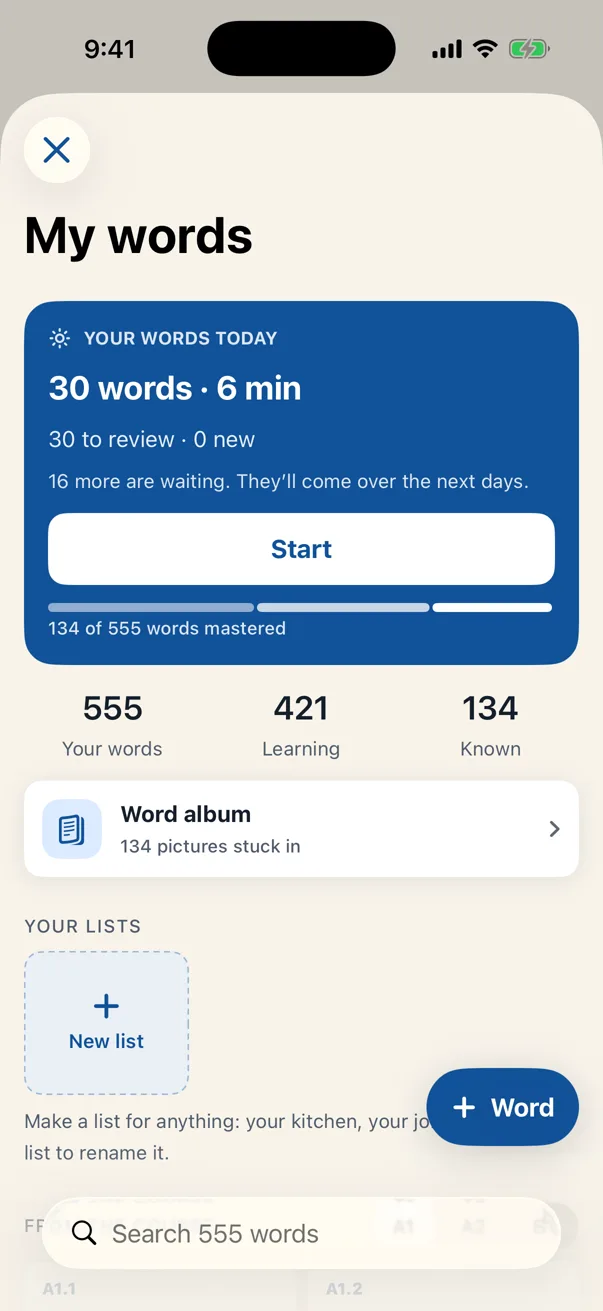
Five new words a day, on a card that changes as you learn each one: meet it, pick its picture by sound, choose der, die or das with the plural, then say or type it in a sentence.
A memory engine schedules every word separately for reading, writing, speaking and listening, so a word you can read but not yet say keeps coming back for speaking.
See how a sound is made.
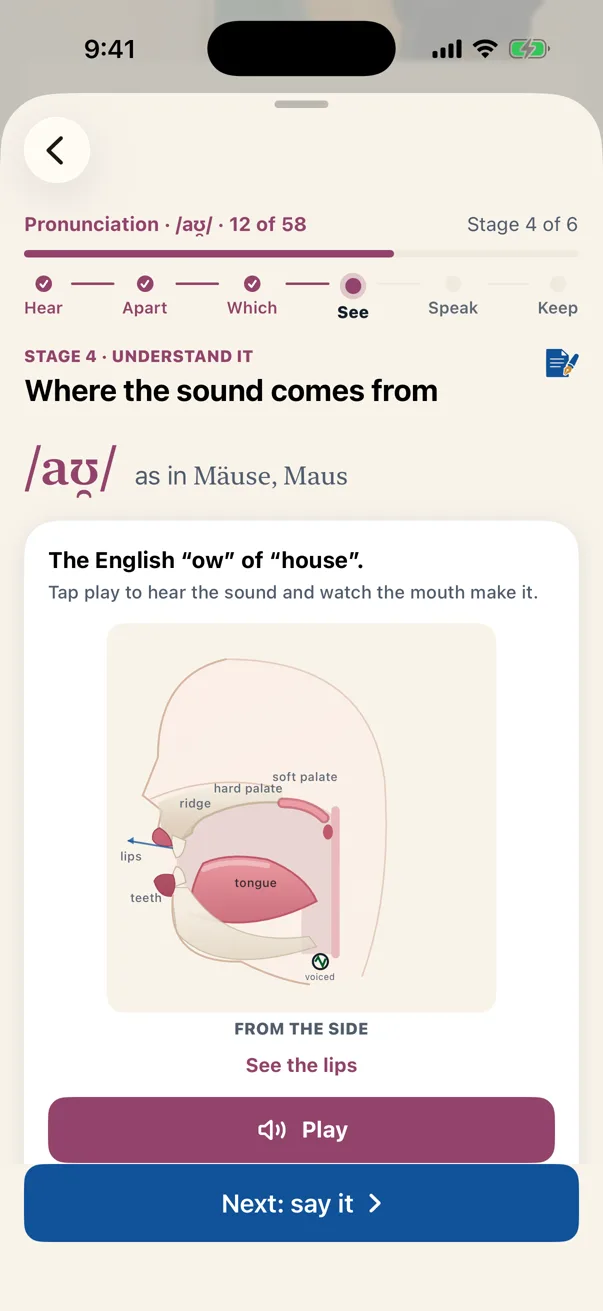
A pronunciation course of its own: 16 units and 103 short lessons, from the alphabet to the sounds English does not have.
- Hütte
- schön
- ich
- ach
- rot
- bitten · bieten
Each sound comes with a drawing of the mouth that moves once, in time with the sound. It shows the tongue, the lips and the jaw, and turns from the front to the side so you see what the mirror cannot.
A three-minute listening drill trains your ear before you speak. Then you say it, see your take next to the model, and shadow the sound in a whole sentence.
On the sound map each sound carries a bar for your ear, filled from those drills, so you can see which sounds still need it.
Talk it through before it counts.
Role-play scenes with an AI partner who plays the landlord, the clerk or the receptionist. You say your part out loud, and the scene’s goals tick off as you meet them. A fresh scene arrives every day.
Stuck? Slow the last line down, or translate it. Live captions show what you are saying, and your speech is recognised on your phone.
Then see what to practise.
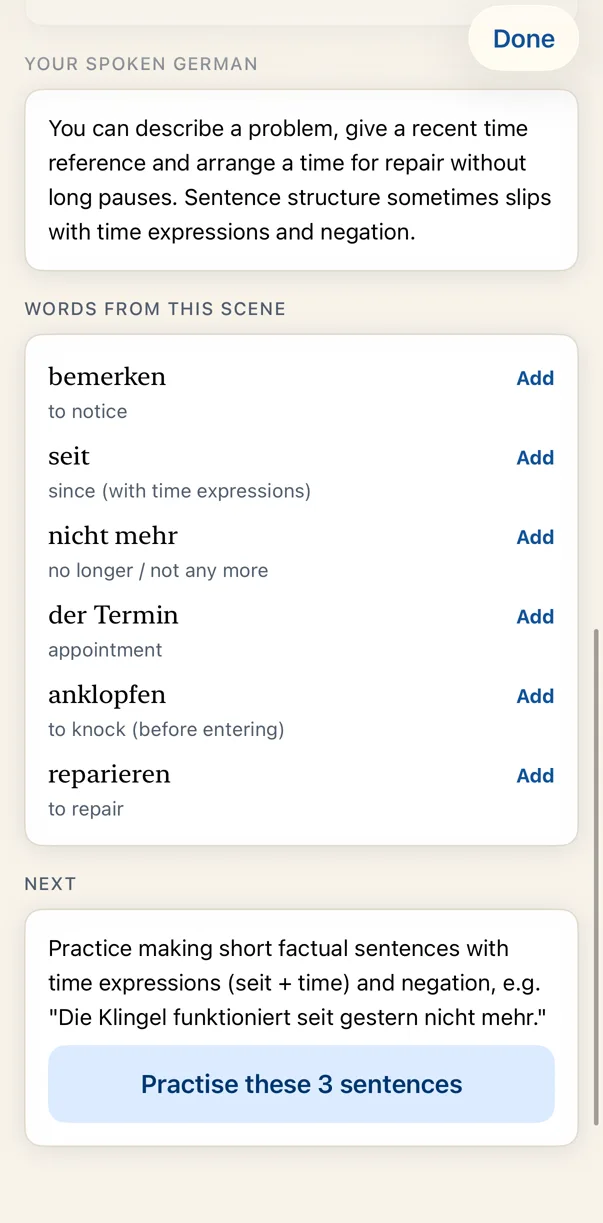
After each conversation you see the words that came out unclear and the sentences worth another go, each with a model to copy.
Free includes three conversations a week. Premium gives you three a day, with your spoken turns scored.
Speaking
Ich hätte gern einen Kaffee.
- Ich96
- hätte58
- gern91
- einen88
- Kaffee93
AI where it helps, checked where it matters.
- An examiner and a conversation partner that answer what you actually said
- Writing marked against the examiners’ criteria, with each correction explained
- A new scene, story episode and listening piece every day, checked against your level first
- Pronunciation scored word by word by Microsoft’s speech service
The course itself is fixed and reviewed, not generated on the fly. Lessons, grammar, mocks and exercises are the same for every learner. Anything written by AI in the moment is labelled.
Private by default.
Some things never leave your device: recognising your speech in conversations, reading your handwriting, translating a line, and checking a written answer for length and content.
You sign in with Apple, and Lautly does not store your Apple ID, name or email address. When your speaking is scored, the recording goes to Microsoft’s speech service in the EU and is not kept after scoring.
Your exam date is already set. Your preparation can be too.
Lautly opens a public beta on TestFlight before its App Store launch in February 2027. Founding testers who send feedback get three months of Premium free when Lautly launches.
Join the beta